


In Pursuit of Revenue Diversification
For many Social Profit organizations, building a more diversified revenue model has become an important priority. As organizations navigate growing demand, evolving funder expectations and increasing financial uncertainty, relying too heavily on a single government contract, one major donor, or an annual fundraising event rarely provides the resilience needed for long-term success.
Yet revenue diversification is not simply about adding more funding sources. The right strategy depends on an organization’s mission, maturity, governance, operating model and capacity to manage greater complexity. Pursued too quickly, or without the right foundations in place, diversification can create new challenges instead of solving existing ones.
These questions were at the heart of our June Social Profit Project Speaker Series, In Pursuit of Revenue Diversification, where leaders from across the social profit, corporate and philanthropic sectors explored what it takes to build resilient organizations that can adapt, grow and maximize their social impact.
Jeff Loomis, Executive Director of Momentum, introduced a framework that shaped the discussion throughout the afternoon. Rather than measuring success by the number of funding sources alone, he encouraged organizations to consider three interconnected dimensions of their revenue model: diversity, longevity and flexibility. Together, they provide a more meaningful way to evaluate whether a revenue strategy is truly strengthening an organization’s long-term resilience.
Building on that foundation, Wafa Kadri, Executive Leader in Social Impact and Corporate Social Responsibility, and Angie Gélinas, President and CEO of the Nonprofit Chamber, expanded the conversation by exploring the realities organizations face as they pursue revenue diversification. Together, the speakers challenged participants to think beyond adding funding sources and instead consider how governance, organizational readiness, partnerships and strategic decision-making all contribute to long-term sustainability.
In this article, we expand on the key ideas shared by Jeff, Wafa and Angie, highlighting practical lessons organizations can use to evaluate their current revenue strategy and strengthen long-term resilience.
Revenue Diversification Should Be An Intentional Strategy
Organizations are often encouraged to diversify their revenue as though adding more funding sources will automatically make them stronger. In reality, the question is not how many revenue streams an organization has, but whether its revenue model is aligned with its mission, operating environment, capacity and long-term strategy.
The right degree of diversification will look different for every organization. For some, it may mean expanding into earned revenue or corporate partnerships. For others, it may mean strengthening existing government relationships or growing unrestricted individual giving. The objective is not to pursue every possible funding source. It is to build a revenue model that supports the organization’s mission while strengthening its long-term resilience.
Diversification also requires organizational readiness. A more complex funding model can require additional fundraising and administrative staff, create more reporting requirements and increase the number of financial systems and relationships an organization must manage. Without the right capacity, organizations risk stretching themselves too thin or pursuing funding opportunities that lead to mission drift.
Building on that point, Angie reminded the audience that revenue diversification requires time, investment and intentional change management. Simply deciding to diversify is not enough. An organization can have multiple revenue streams and still be vulnerable if those sources are short-term, highly restricted or unpredictable. Diversification alone does not create resilience. The quality, stability and flexibility of those revenue sources matter just as much.

Jeff Loomis, Executive Director of Momentum, presents the keynote at Bespoke’s June Social Profit Project Speaker Series, In Pursuit of Revenue Diversification.
Why Momentum Chose Diversification
Momentum consciously accepted the complexity that comes with managing a diversified revenue model because the organization believes it provides greater flexibility and independence as it works toward an economy that works better for everyone.
Jeff identified two primary reasons Momentum has continued to pursue diversification.
Deal With Dips
A broader mix of revenue sources gives Momentum greater flexibility when one funding stream declines or changes. It reduces the organization’s dependence on any single source and allows it to adjust during periods of uncertainty.
That resilience cannot be built overnight. It depends on establishing and stewarding relationships well before the organization needs to rely on them.
Protect Your Power
Diversification can also help organizations maintain greater autonomy over how they pursue their mission.
As Jeff explained, no single funder is Momentum’s boss.
A balanced funding model helps protect the organization’s ability to make strategic decisions, determine its activities and advocate publicly, professionally and persistently for policy change.
It allows Momentum to remain accountable to its mission without becoming overly beholden to one funding source.
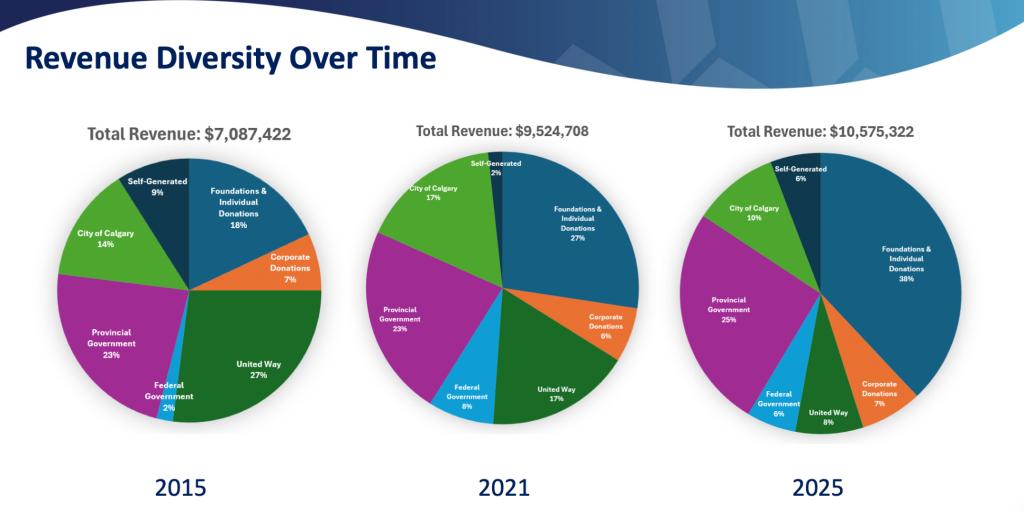
Momentum’s revenue composition from 2015 to 2025 highlights how its funding strategy evolved to support long-term organizational sustainability.
When considering revenue diversification, Jeff encouraged organizations to assess three factors together:
Diversity: How many different sources of revenue does the organization have?
Longevity: How stable and long-term are those sources?
Flexibility: How much discretion does the organization have over how the funding is used?
Long-term, unrestricted funding may provide considerably more organizational value than short-term, highly restricted funding, even when the dollar amount is similar.
Jeff suggested mapping funders according to their longevity and flexibility, with the size of the contribution represented separately. This can help organizations distinguish between “builder” funders that invest in organizational capacity and “buyer” funders that purchase a particular program, output or outcome.
Both can have a place within a revenue model, but they support the organization in different ways.
The strength of a funding strategy therefore depends not only on the number of sources, but on the quality, stability and flexibility of those relationships.
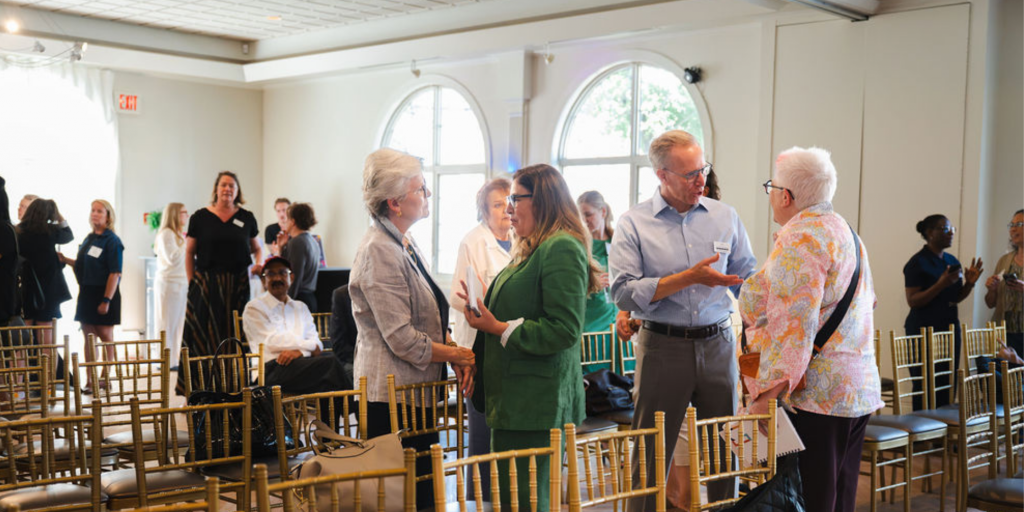
One of the hallmarks of the Social Profit Project Speaker Series is the opportunity for continued dialogue, as panelists Wafa Kadri and Angie Gélinas connect with attendees following the discussion.
Fund the Organization, Not Only the Project
The panel then turned to the role corporations and philanthropic funders can play in helping social profit organizations innovate and build resilience.
Wafa shared that corporate community investment budgets may not necessarily be shrinking. Instead, corporate funding is becoming more strategic, with larger investments often directed toward fewer issues and longer-term priorities.
Companies are increasingly looking for opportunities where an important social issue also connects to their business, values and long-term interests. For social profit organizations, this makes it increasingly important to be in the right rooms and build relationships with companies whose priorities genuinely align with their mission.
Rather than approaching corporate partnerships solely as a funding opportunity, organizations should ask a different question: Where is the shared value?
The strongest partnerships are built when both organizations are advancing their respective mandates. If that connection is not immediately obvious, it can be valuable to seek perspectives from board members, advisors or partners who may identify opportunities that are not immediately visible.
At the same time, Wafa emphasized that funding models themselves must evolve if organizations are expected to innovate, scale and respond to increasingly complex social issues.
Funders can play a critical role by moving beyond supporting isolated projects and investing in the long-term strength of organizations. This may include providing flexible operating funding, investing in infrastructure and organizational capacity, co-investing alongside other funders and creating space for organizations to test new ideas without requiring every initiative to deliver predetermined outcomes.
Fund the Attempt, Not Only the Outcome
Both Wafa and Angie emphasized the need to normalize risk-taking and failure.
Businesses regularly invest in new ideas knowing that some will not succeed. Social profit organizations, however, are often asked to innovate while working within funding agreements that leave little room for experimentation or learning.
Angie encouraged funders to consider funding the attempt, rather than only paying for a successful outcome.
Innovation requires organizations to test ideas, learn from what does not work and apply those lessons to their next approach. Without the freedom to fail, organizations are unlikely to pursue the ambitious strategies needed to respond to changing community needs.
Wafa suggested that funders could build this into their investment portfolios by directing:
- 70 per cent toward proven programs that are delivering results
- 20 per cent toward scaling promising ideas
- 10 per cent toward experimentation, where the intended outcome is learning
Innovation and sustainability require trust, flexible capital and the freedom to learn from failure.

The Social Profit Project Speaker Series creates space for sector leaders to exchange ideas, strengthen partnerships and continue the conversation beyond the stage.
Collaboration Must Matter More Than Ownership
The scale and complexity of the issues facing communities also require funders to work differently with one another.
Rather than investing independently and focusing on individual brand recognition, Wafa encouraged corporations and philanthropic organizations to consider collective funding models.
Co-investment can bring more resources, perspectives and expertise to the table while reducing duplication and allowing partners to address challenges at a systems level.
This requires funders to become less concerned with owning an initiative and more willing to participate authentically in a shared solution.
Start With Self-Awareness
The event closed with an important message. Revenue diversification is not a quick fix. It is a long-term organizational capability that must be developed deliberately.
There is significant pressure on organizations to diversify, but the strategy must begin with an honest understanding of the organization’s current position.
Before pursuing a new funding stream, organizations should assess their capacity, study the opportunity and become clear about what success would require.
Ultimately, revenue diversification is not the objective. It is one of many strategic tools organizations can use to strengthen their mission, build resilience and create lasting impact.
Every organization’s path looks different.
There is no one-size-fits-all approach to revenue diversification. Through Bespoke’s strategic planning services and Social Profit Compass, we help organizations assess their current position, identify opportunities and develop practical strategies that align revenue decisions with mission, capacity and long-term impact.
Connect with our team to learn how we can support your organization.